This blog is the official class blog of Escenarios Regionales del Mundo Contemporaneo 2009. (Blog 2)
Students, you will use this blog to post anything interesting that you find, comment on each other's findings, and generally write reflections of classes so that everyone is learning together and contributing to making this blog a real online space in which we can discuss important world issues. This is in addition to other online spaces on YouTube, and the class wiki.
This weekend, six Chinese Uighurs, arrested in 2001, were released from Guantanamo Bay. Their release had been delayed because they couldn’t return to China, since they would be prosecuted there as terrorists, but now they have been taken to the tropical island of Palau. This news reminds us of Obama’s promise to close the Cuban detention facility before January, which now seems quite unlikely to be kept, since the deadline gets closer and no significant difference has been made. Over the past eight months, only 26 detainees have been freed, and 215 remain.
"The detention facilities at Guantanamo for individuals covered by this order shall be closed as soon as practicable, and no later than 1 year from the date of this order"
As we all know, the vast majority of the weapons used by drug dealers and criminal organizations in our country come from the United States. Prominent politicians like Barack Obama and Hillary Clinton have gone as far as to say that roughly 90% of the guns that have been recovered come from their country. Could those numers be right?
First of all, we should have a good idea of the guns that have been recovered by the Mexican police. However, all attemps to find a solid number have been unsuccessful, since estimated numbers say that less than 20% of the guns recovered have been traced back to the United States, which leaves us to wonder: what in the world happens with the other ones? As one can expect, no official word has been said by the Mexican authorities.
Although it is expectable that the majority of the weapons used in Mexico come from the United States, due to ease with which they can be transported, this brings a lot of things into question. Without a doubt, the most important is what happens with all the weapons that are not traced back to their origin. The least dangerous example would be if the Mexican police kept them, but what if they do not? What if they come back to the criminal organizations, which is plausible, due to the corruption levels in our country?
So, what do you think that happens with that arsenal, is it used for good or not? Feel free to share your opinion...
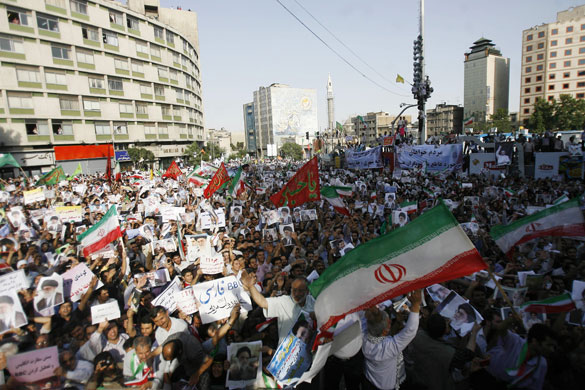
As you may know, the Iranian presidential election held in June was a very controversial one. To this day, there are thousands of protesters who come out and fight to take down the regime. However, Obama may have commited and enormous mistake when he manifested that he would be willing to give his support to the Iranian rebels.
Today, in the 30-year anniversary of the American embassy takeover in Tehran, protesters are asking Obama to stnd up to his word and help them. They yell such things as "Obama, Obama! Either with them or with us!" The "them" in the chant means Ahmadinejad (their president) and the regime that is in possession of the country.
Now Obama has a big problem, because in one hand he has a percentage of the population that are on his side, but only if he helps them. On the other hand, he has the authorities of the country who are negotiating a nuclear deal with the United States.
So... what will Obama do now?
To know more about this, please visit the page below...
Yesterday, thousands of Iranian people went out on the streets of Tehran to demonstrate against the current regime. Outside the former US embassy, there was an anti-American rally to mark the 30th anniversary of the seizure of the embassy by Islamist students. In November 1979, 52 American diplomats had been taken hostage at the embassy, and kept there for over a year by supporters of the Iranian Revolution.
Wednesday, the occasion was seized by opposition supporters, who gathered in Haft-e Tir square to voice their discontent with the regime. Protesters, who claim that the June presidential elections were manipulated to ensure the reelection of President Mahmoud Ahmadinejad, were chased by security forces. Witnesses say that batons and tear gas were used to disperse the crowd as well as open fire. Since the elections, at least 30 protesters have been killed in clashes and thousands have been arrested, while 200 opposition activists are now in jail.
23 Americans, including a CIA agent, as well as two Italian secret agents, have been convicted for the 2003 kidnap of Hassan Mustafa Osama Nasr, known as Abu Omar. This Muslim cleric was abducted from Milan and sent to Germany and then Cairo, where he was allegedly tortured and held for four years without any charge. The trial against his captors was part of the CIA’s extraordinary rendition program, and was held at the court in Milan. Robert Lady, the CIA's Milan station chief at the time, was given an eight-year term, while the other 22 Americans were sentenced to five years in prison, and the two Italian agents were given three-year terms.
The past Afghan elections caused much controversy due to its highly publicised corruption. A couple of my fellow bloggers talked about Abdullah quitting the running towards becoming Afghanistan's next president. But, does he have an As up his sleeve?
"One cannot toy with the people's suffrage," were his words last week referring to Karzai's doubtful innocence. But one of his strategies to become president is to call to new presidential elections this next year, elections that will happen during the same time as the legislative elections thus creating the opportunity to create a new political scenario. Abdullah hopes that the damage caused on Karzai's image proves to be enough to make the White House seek some changes in the Afghan politics to help them carry on with the American military strategy.
But the United States, who have in the past criticised Karzai's leadership, seemed to have accepted the Afghan political panorama. Obama's advisor, David Axelrod, stated recently that since most polls showed Abdullah would have lost the second round, they were going to "deal with the already set government."
The objective of the second round was to obtain back the lost credibility needed to carry on with war against Talibans. Obama said that he wouldn't send any more troops to Afghanistan until a new government in Tabul is declared.
I couldn't believe the news, but here's the press release from Nobelprize.org:
The Norwegian Nobel Committee has decided that the Nobel Peace Prize for 2009 is to be awarded to President Barack Obama for his extraordinary efforts to strengthen international diplomacy and cooperation between peoples. The Committee has attached special importance to Obama's vision of and work for a world without nuclear weapons. Obama has as President created a new climate in international politics. Multilateral diplomacy has regained a central position, with emphasis on the role that the United Nations and other international institutions can play. Dialogue and negotiations are preferred as instruments for resolving even the most difficult international conflicts. The vision of a world free from nuclear arms has powerfully stimulated disarmament and arms control negotiations. Thanks to Obama's initiative, the USA is now playing a more constructive role in meeting the great climatic challenges the world is confronting. Democracy and human rights are to be strengthened. Only very rarely has a person to the same extent as Obama captured the world's attention and given its people hope for a better future. His diplomacy is founded in the concept that those who are to lead the world must do so on the basis of values and attitudes that are shared by the majority of the world's population. For 108 years, the Norwegian Nobel Committee has sought to stimulate precisely that international policy and those attitudes for which Obama is now the world's leading spokesman. The Committee endorses Obama's appeal that "Now is the time for all of us to take our share of responsibility for a global response to global challenges."
Some weeks ago, Foreign Affairs published this short article about the CIA and its interrogation methods, when a prosecutor was appointed to review their operatives’ behavior in past cases. The American intelligence community has always had a reputation of torture practices, and it was precisely to prosecute those cases of unlawful behavior that this review was launched. This investigation has created a lot of controversy in the US, since there are a lot of people who think a prosecution of the CIA is not in the country’s best interest. On the other hand, many have complained that the investigation is too feeble, and not comprehensive enough.
Well, since we won’t have any videos this week, and teams won’t be analyzing any new issues, I’d like to share a link to a short article that I found on Foreign Affairs some time ago. I think this article is quite interesting to analyze, especially because its content is closely related to what we have seen in class during this partial.
This article discusses the reasons behind a new tariff that the Obama administration placed on imported Chinese tires, after a petition was filled by the United Steelworkers Union. Some claim this tariff was necessary, since the great percentage of Chinese imports (17% of tires in the US) caused American factories to close. Most analysts, however, comment on the negative outcomes that this decision could have. First of all, many are concerned about a Chinese reprisal against American products, which could end up in an escalation of protectionism between the economies of these two countries, or even trade war. Then, there’s the risk of raising Chinese nationalism or of triggering China’s return to a more closed market. Besides, this shouldn’t have happened just before the G-20 summit, when cooperation between these powerful countries was most needed.
Early this month, the Cuban government claimed Barack Obama was not doing enough to end the US trade embargo against the island despite his promise to improve ties. Regardless of Cuban Foreign Minister's statement of the embargo being "obsolete and unacceptable," the US president extended it for one more year and made it clear that the ban would only come down if Cuba were willing to free political prisoners and improve human rights.
However, in a sign of thawing relations, he has eased travel restrictions for Americans wanting to visit Cuba and the two countries are holding direct talks on immigration.
Now recently, it appears that a senior American diplomat has held high-level talks with the Cuban government in Havana. The talks between the two nations were the first of their kind in years.
Cuba's President Raul Castro has previously said he is prepared to negotiate with the Obama administration, providing there are no preconditions. His brother, former President Fidel Castro, also last week praised Mr Obama for his commitment to tackling climate change.
The tense relation between these two countries is not at all recent, the conflict goes back to the mid-XX Century; their different ideologies make it apparently impossible to have a better relationship than the one they already have. I, for one, don't think President Obama, or any future American president for that matter, will remove the embargo if Cuba refuses to change its entire country's way of thinking. Communism has been one of America's foes for a long time, and Cuba is no exception.
The world of cinema would not have been the same without Roman Polanski, director of the classic “Chinatown” and famous “The Pianist”, both of them films that helped this man climb up high and jump directly into the restricted rank of legendary and well-respected moviemakers.
During these last few days, his name has been filling the news and tabloids, making headlines all around the world. His initial intentions of attending a ceremony to receive an award for his career achievements were utterly altered by his unexpected arrest in Switzerland, after the US gave orders of finally capturing Polanski.
The incident itself aroused a long catalogue of conflicting opinions. And that is just a side of the story, for his arrest has now escalated into an international-scale concern. I was extremely surprised after reading about France and Poland’s requests for the liberation of the filmmaker. It really made my neurones work a little bit harder –and my heart too, if you wish-. Of course it disappointing and extremely heartbreaking that someone you admire is being held under the force of the law, accused for a criminal act, and knowing he is being arrested for it. But we live in a world controlled by rules and his case is nowhere far from having violated them—he even pledged guilty about his accusation years ago and so he fled to France. Had it been an unrecognized person, stranger for most of the world, his actions would have been fiercely condemned at the very least. Rape is not one of the usually forgiven crimes, but one of those that keep you under the scrutiny of public eye, the harsh words spoken by innumerable tongues, and the punishments of our beloved justice. Our beloved justice I said… really? We seem to only ask for her divine intervention when we want her to. It might be because we never promised justice our unconditional love (though we make her believe we did… and we also fooled ourselves thinking the exact same thing). That must be it. And Polanski’s case is showing how we can easily bend and soften the law whenever we feel it is most “appropriate”. I repeat: I truly admire him for his work, but rape… that is another thing. How could he possibly be above law? Why should he receive more compassion and help from authorities than the rest of men and women that have been sent to jail because of the same crime? This event is really putting at stake the credibility of our laws and the respect we have for them. The issue here goes beyond Roman Polanski's legal condition and the feast his situation is giving to entartainment TV channels. It is about the commitment of our governments towards the law.
The real problem was that this case was not solved since the very beginning. Why did it take the US so much time to try to reinitiate the trial? Did they said: “Oh, well, we’ll free the man and let him do more movies for us, yay” And then what? They did not like his most recent films and tried to arrest him then? Honestly, it is not like he was secretly hidden!
Also, why is Switzerland taking an active role in all this disaster so suddenly? Polanski has been spent years coming and going out of the country without any single problem and, as reports mention, he even has a property there! It is kind of weird that the Swiss authorities decide to arrest him all of the sudden.
And meanwhile, France and Poland have already sent a message to Hillary Clinton so she can take action and reflect on their desire of releasing Roman Polanski and drop out his process of extradition to the US. Sarkozy has requested a rapid solution for all this drama.
Just for your own reflections, a series of quotes done by Frédéric Mitrerrand, Minister of Culture and Communication of France concerning Polanski’s arrest:
"In the same way that there is a generous America that we like, there is also a scary America that has just shown its face."
And from French Foreign Minister, Bernard Kouchner:
"It's a little sinister, this business, to be quite frank.”
For more information in case you are interested :)
http://www.nzherald.co.nz/entertainment/news/article.cfm?c_id=1501119&objectid=10600231
http://www.emorywheel.com/detail.php?n=27405
http://www.abcnews.go.com/Entertainment/roman-polanski-arrested-switzerland-faces-extradition-1977-statutory/story?id=8685935
http://www.ft.com/cms/s/0/378af0e0-ac62-11de-a754-00144feabdc0.html?nclick_check=1
http://www.timesonline.co.uk/tol/news/world/europe/article6851581.ece
I just read about how USA and North Korea are willing to talk bilaterally to reach an agreement in the North Korean Nuclear program. After North Korea talked to Chinese, Japanese, Russian and South Koreans representants North Korea is willing to reach an agreement. Is really N. Korea willing to convert from realist to Liberalist. Check the next link and tell me what you think.
I especially think that maybe this a tactic of North Korea to trick USA and the UN. We have seen in history that this small country is not willing to negotiate so , Why now?
Let's keep on reading the news and wish this has a happy ending.
Nowadays having the greatest military power is not the decisive factor to be the most powerful country; however, it still sets apart world powers from other nations. Nuclear weapons are by far the most destructive ones in existence; and the proper regulation of their use is of outmost importance for the welfare of our world. The magnitude of their power is so big that they have been used for war only once, at the end of World War II, when their devastaing effects made us realize that a nuclear war could equal the destruction of humanity.
Here's a link to a video about the Russian "Tsar Bomba":
Since the Cold War, several treaties to control the number of nuclear weapons have been made, and most of them also regulate the development of new nuclear technology. This is supposed to protect the security of our world; however, the fact that these nuclear weapons exist, and are ready to be used is worrying enought if we consider that just in the US, there are enough nuclear missiles to destroy our world several times over.
During the mid-nineteenth century, Cuba was one of the most highly developed Latin American countries; it had plenty of American industries and landowners, and the Cuban-American relationships were quite healthy. However, most of the population was in severe poverty, since only a small minority benefited from all of these industries, and a great part of the earnings went to the USA. This raised a nationalist resentment that set the conditions for a revolution.
It was during Batista’s government that a group of revolutionaries led by Fidel Castro overthrew the regime and started a revolution to redesign the social, politic and economic system of the country. The Revolution succeeded and Cuba became the first communist Latin American country, achieving great advances in education and health, but having sacrificed its previous economic prosperity.
After the Revolution, Cuba lost its earlier American support and the long political conflict between these two countries just started. However, Cuba was not alone: as these were the times of the Cold War, the Soviet Union helped Cuba reorganize, and supplied its new communist ally with weapons and other resources.
Aerial Photograph of Missiles in Cuba
Some years later, in 1962, the Soviet Union installed medium range nuclear missiles in Cuba, which was considered as a threat by the US and led to the Cuban Missile Crisis. As we studied in class, this conflict never resulted in an actual war, and the Soviets eventually removed the missiles after an American blockade. However, all these conflicts and negotiations brought about disagreements between the Cuban government and the USSR, and the relations between these two countries started to decline.
At the end of Cold war, Cuba remained as one of the few communist nations still standing, along with China and North Korea. With the collapse of the USSR, the Cuban government lost its great ally, while the conflicts -as well as the trade embargo- with the United States continued. Now that the US had become the only superpower, its influence over the whole international system was unmatched, and Cuba’s emarginated economy suffered stagnation and shortages of all kinds.
References: "Latin America, history of." Encyclopædia Britannica. 2009. Encyclopædia Britannica Online. 06 Sept 2009 http://search.eb.com/eb/article-60819. Goldstein, Joshua .S, and Jon C. Pevehouse. International Relations. 8th ed. New York: Pearson/Longman, 2009. p. p. 26-37
During the Cold War, Chile was one of the countries most affected by the US Policy of Containment. With the support of the United States, Augusto Pinochet –the Chilean commander in chief– planned and led a coup to overthrow socialist president Salvador Allende in 1973, and assumed the presidency of his country in 1974.
Pinochet intended to eliminate the leftist or socialist party, and to introduce a free-market economy in Chile. During the period from 1976 to 1979, his policies seemed to work, since they lowered inflation and created an economic boom; however, the country went through a severe recession some years later. During Pinochet’s regime, oppression towards his opponents was brutal: just during his first three years in power, he arrested over 130 000 people and several more were reported “missing”. After leaving office in 1990, he was repeatedly accused of violating human rights and tried for torture and human rights abuses.
The rise of the Soviet Union and the dominance that it acquired after the Second World War were reasons enough to create certain “paranoia” in the United States, a fear of communism spreading worldwide. Though we could also say it was not an unfounded alarm, but a reality likely to happen. To defend democracy from the threat awaken by growing communism, the United States adopted its famous policy of containment (as we saw in class). In 1947, president Truman said that it was the United States’ duty to help any country vulnerable to fall to communism. Out from this idea, the United States began to take various actions. One of them was the Truman Doctrine, the “beginning” of American war against communism. After World War II, the United Kingdom supplied some countries, such as Greece and Turkey, with financial aid. However, the UK reached a point where it was unable to carry on with the help, so they asked America for a plan B. The reason why it was important to continue contributing with these two countries was that Greece was going through a civil war and Turkey was still on a process of recovering and modernization, which made them susceptible to adopt communism one day or another. American support resulted in the defeat of the Greek Communist Party. But this was not the only consequence. The importance of Truman Doctrine and the policy of containment, established within American minds, led later to “bigger” things, such as the involvement of the United States in the Vietnam and Korean war.
Was it all worth it? Was it really America's responsibility to maintain communism aside? Was it the right way to stop communism?
For more information: http://www.conservapedia.com/Truman_Doctrine http://www.johndclare.net/cold_war8_TrumanDoctrine.htm http://books.google.com.mx/books?id=qXeRALIwozgC&pg=PA268&lpg=PA268&dq=greece+communism+us+truman+doctrine&source=bl&ots=hymjFEMYBa&sig=Suh2WYEmasrAIEJXGF12y2xdsqU&hl=es&ei=oHqbSoeMEY_-tQOsm_iUDg&sa=X&oi=book_result&ct=result&resnum=6#v=onepage&q=&f=false http://www.u-s-history.com/pages/h1780.html