Showing posts with label A00904878. Show all posts

Thursday, November 5, 2009

More detainees released from Guantanamo Bay

This weekend, six Chinese Uighurs, arrested in 2001, were released from Guantanamo Bay. Their release had been delayed because they couldn’t return to China, since they would be prosecuted there as terrorists, but now they have been taken to the tropical island of Palau. This news reminds us of Obama’s promise to close the Cuban detention facility before January, which now seems quite unlikely to be kept, since the deadline gets closer and no significant difference has been made. Over the past eight months, only 26 detainees have been freed, and 215 remain.


"The detention facilities at Guantanamo for individuals covered by this order shall be closed as soon as practicable, and no later than 1 year from the date of this order"

(Obama; January 22, 2009).


Here's the original article:
Washington Post - Six more released from Guantanamo Bay

Read More......

Recent news on the Arab-Israeli conflict

The Israeli navy intercepted yesterday an Antiguan vessel carrying hundreds of tons of Iranian weapons, including rockets, hand grenades, mortars and at least 3,000 missiles, allegedly intended for Hezbollah. The ship, Francop, was a 100 miles off the Irsaeli coast, and had "dozens of shipping containers, carrying numerous weapons, disguised as civilian cargo among hundreds of other containers on board". The crew was apparently unaware of the smuggling, and the Israeli military searched the Francop with the permission of its captain. A spokesperson said that "the weapons originate from Iran and were intended to reach the Hezbollah terror organization for use against the state of Israel and its citizens", but Iran and Syria have both rejected Israel's accusations. Hezbollah denied any link to the weapons, and accussed Israel of piracy in international waters.


Here's the link to the orginal article
Another article, where Hezbollah denies any link to the weapons.

Read More......

Wednesday, November 4, 2009

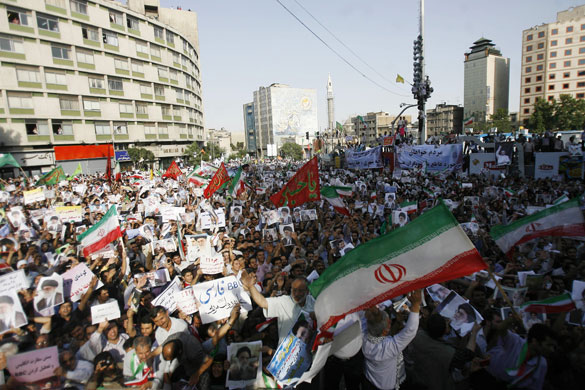
Iran police crushes demonstrations

Yesterday, thousands of Iranian people went out on the streets of Tehran to demonstrate against the current regime. Outside the former US embassy, there was an anti-American rally to mark the 30th anniversary of the seizure of the embassy by Islamist students. In November 1979, 52 American diplomats had been taken hostage at the embassy, and kept there for over a year by supporters of the Iranian Revolution.


Wednesday, the occasion was seized by opposition supporters, who gathered in Haft-e Tir square to voice their discontent with the regime. Protesters, who claim that the June presidential elections were manipulated to ensure the reelection of President Mahmoud Ahmadinejad, were chased by security forces. Witnesses say that batons and tear gas were used to disperse the crowd as well as open fire. Since the elections, at least 30 protesters have been killed in clashes and thousands have been arrested, while 200 opposition activists are now in jail.


Here’s the original article, in case you want to read more:
BBC News - Iran police clash with protesters

Read More......

CIA agents convicted for the kidnap of a Muslim cleric

23 Americans, including a CIA agent, as well as two Italian secret agents, have been convicted for the 2003 kidnap of Hassan Mustafa Osama Nasr, known as Abu Omar. This Muslim cleric was abducted from Milan and sent to Germany and then Cairo, where he was allegedly tortured and held for four years without any charge. The trial against his captors was part of the CIA’s extraordinary rendition program, and was held at the court in Milan. Robert Lady, the CIA's Milan station chief at the time, was given an eight-year term, while the other 22 Americans were sentenced to five years in prison, and the two Italian agents were given three-year terms.


Abu Omar in Milan, 2007


Here’s the link to the original article:
BBC News - CIA agents guilty of Italy kidnap

Read More......

Sunday, October 11, 2009

Obama wins Nobel Prize!

I couldn't believe the news, but here's the press release from Nobelprize.org:


The Norwegian Nobel Committee has decided that the Nobel Peace Prize for 2009 is to be awarded to President Barack Obama for his extraordinary efforts to strengthen international diplomacy and cooperation between peoples. The Committee has attached special importance to Obama's vision of and work for a world without nuclear weapons.
Obama has as President created a new climate in international politics. Multilateral diplomacy has regained a central position, with emphasis on the role that the United Nations and other international institutions can play. Dialogue and negotiations are preferred as instruments for resolving even the most difficult international conflicts. The vision of a world free from nuclear arms has powerfully stimulated disarmament and arms control negotiations. Thanks to Obama's initiative, the USA is now playing a more constructive role in meeting the great climatic challenges the world is confronting. Democracy and human rights are to be strengthened.
Only very rarely has a person to the same extent as Obama captured the world's attention and given its people hope for a better future. His diplomacy is founded in the concept that those who are to lead the world must do so on the basis of values and attitudes that are shared by the majority of the world's population.
For 108 years, the Norwegian Nobel Committee has sought to stimulate precisely that international policy and those attitudes for which Obama is now the world's leading spokesman. The Committee endorses Obama's appeal that "Now is the time for all of us to take our share of responsibility for a global response to global challenges."


And here's a video with the official anouncement:

What do you think about this? I'd be glad to read some comments.

Read More......

Thursday, October 1, 2009

60th Anniversary of Communist Rule in China

Yesterday, the Chinese were celebrating the 60th anniversary of the founding of the People's Republic of China by Mao Zedong, which took place on 1 October 1949. The celebrations in Beijing started when President Hu Jintao appeared on Tiananmen Square, along with some former Chinese leaders. Then, the Chinese flag was raised in the center of the square, and a huge military parade with tanks, soldiers and missile launchers started. Finally, the president gave a speech praising China’s progress and their nation’s promising future.


Here’s a link to an article about the celebrations in Beijing
BBC News - China marks Communist anniversary

Here’s a link to a video with images of the parade
YouTube - China's 60th anniversary parade 2009, Tian'an Men Square, Beijing

Anf finally, a video on Chinese art and politics:
BBC News - Audio slideshow: Art and politics in China


Mao Zedong

Read More......

CIA Investigated For Torture

Some weeks ago, Foreign Affairs published this short article about the CIA and its interrogation methods, when a prosecutor was appointed to review their operatives’ behavior in past cases. The American intelligence community has always had a reputation of torture practices, and it was precisely to prosecute those cases of unlawful behavior that this review was launched. This investigation has created a lot of controversy in the US, since there are a lot of people who think a prosecution of the CIA is not in the country’s best interest. On the other hand, many have complained that the investigation is too feeble, and not comprehensive enough.


Here’s the link to the article, and please feel free to comment.
Foreign Affairs - CIA Probe and the Torture Debate

Read More......

More on the Tsunami

I see that someone has already made a post on the Tsunami, but I’d like to add some new information. Since this natural disaster devastated Samoa and American Samoa, rescue workers have been looking for survivors, and planes have been carrying air supplies. The UN said it would send an emergency team to the Samoan islands, where villages were devastated and up to 145 people died. The Samoan Prime Minister said that devastation was complete, and that there were some villages in which no house was left standing after the waves that originated from last Tuesday’s earthquake reached the islands.


Here’s a link to a page with more information and videos
BBC News - Tsunami rescue begins in Pacific


Read More......

A New Barrier to American-Chinese Trade

Well, since we won’t have any videos this week, and teams won’t be analyzing any new issues, I’d like to share a link to a short article that I found on Foreign Affairs some time ago. I think this article is quite interesting to analyze, especially because its content is closely related to what we have seen in class during this partial.

Here’s the link to Robert McMahon’s “Daily Analysis”:
Foreign Affairs - Ill Trade Winds with Beijing

This article discusses the reasons behind a new tariff that the Obama administration placed on imported Chinese tires, after a petition was filled by the United Steelworkers Union. Some claim this tariff was necessary, since the great percentage of Chinese imports (17% of tires in the US) caused American factories to close. Most analysts, however, comment on the negative outcomes that this decision could have. First of all, many are concerned about a Chinese reprisal against American products, which could end up in an escalation of protectionism between the economies of these two countries, or even trade war. Then, there’s the risk of raising Chinese nationalism or of triggering China’s return to a more closed market. Besides, this shouldn’t have happened just before the G-20 summit, when cooperation between these powerful countries was most needed.

Read More......

Sunday, September 27, 2009

Angela Merkel Wins German Election

Angela Merkel had an astounding victory over Social Democrat Frank-Walter Steinmeier. The SPD has its worse result since WWII, and Steinmeier said it was a "bitter election defeat". Merkel will remain in office for her second term, with the intention to be "the Chancellor of all Germans".


Here's a video where Frank-Walter Steinmeier admits his defeat:

Here's another video, with Merker's victory speech:
YouTube - Victorious Merkel vows to lead Germany out of slump

And finally, a link to a short article from the BBC, just in case you want to read some more:
http://news.bbc.co.uk/2/hi/europe/8277912.stm

Read More......

Friday, September 11, 2009

World War I and the 1917 Russian Revolution

During World War I, the Russian army was ill-equipped and poorly led by the tsar, and Russia was suffering catastrophic losses in campaign after campaign against German armies. The war showed that the country was no longer a military match for the nations of Central and Western Europe, and it hopelessly disrupted the economy.

In Petrograd, riots over the scarcity of food broke out and Tsar Nicholas II was forced to abdicate. A committee of the Duma appointed a Provisional Government, but the Petrograd Soviet of Workers' and Soldiers' Deputies soon proved to have greater authority. Although the Provisional Government was unable to cope adequately with the major problems afflicting the country (peasant land seizures, nationalist independence movements, and the collapse of army morale at the front) it wanted Russia to continue participating in WWI. On the other hand, the soviets, which were in far closer contact with the sentiments of the people, favored Russian withdrawal from the war on almost any terms.


Aleksandr F. Kerensky became head of the Provisional Government, which was increasingly unable to halt Russia's slide into political, economic, and military chaos. But while its power waned, that of the soviets was increasing, as was the Bolsheviks' influence within them.

By autumn, the Bolshevik program of “peace, land, and bread” had won the party considerable support among the hungry urban workers and the soldiers, who were already deserting from the ranks in large numbers. On October 24 and 25 the Bolsheviks staged a nearly bloodless coup, occupying government buildings, telegraph stations, and other strategic points, and overthrowing Kerensky from power.

References:
"Russian Revolution of 1917." Encyclopædia Britannica. 2009. Encyclopædia Britannica Online. 11 2009 .

Read More......

Nuclear Weapons

Nowadays having the greatest military power is not the decisive factor to be the most powerful country; however, it still sets apart world powers from other nations. Nuclear weapons are by far the most destructive ones in existence; and the proper regulation of their use is of outmost importance for the welfare of our world. The magnitude of their power is so big that they have been used for war only once, at the end of World War II, when their devastaing effects made us realize that a nuclear war could equal the destruction of humanity.

Here's a link to a video about the Russian "Tsar Bomba":


Since the Cold War, several treaties to control the number of nuclear weapons have been made, and most of them also regulate the development of new nuclear technology. This is supposed to protect the security of our world; however, the fact that these nuclear weapons exist, and are ready to be used is worrying enought if we consider that just in the US, there are enough nuclear missiles to destroy our world several times over.


Click here to see a chronological list
of the treaties and agreements on nuclear weapons.

Read More......

Cuban Revolution and the Missile Crisis

During the mid-nineteenth century, Cuba was one of the most highly developed Latin American countries; it had plenty of American industries and landowners, and the Cuban-American relationships were quite healthy. However, most of the population was in severe poverty, since only a small minority benefited from all of these industries, and a great part of the earnings went to the USA. This raised a nationalist resentment that set the conditions for a revolution.


It was during Batista’s government that a group of revolutionaries led by Fidel Castro overthrew the regime and started a revolution to redesign the social, politic and economic system of the country. The Revolution succeeded and Cuba became the first communist Latin American country, achieving great advances in education and health, but having sacrificed its previous economic prosperity.

After the Revolution, Cuba lost its earlier American support and the long political conflict between these two countries just started. However, Cuba was not alone: as these were the times of the Cold War, the Soviet Union helped Cuba reorganize, and supplied its new communist ally with weapons and other resources.


Aerial Photograph of Missiles in Cuba


Some years later, in 1962, the Soviet Union installed medium range nuclear missiles in Cuba, which was considered as a threat by the US and led to the Cuban Missile Crisis. As we studied in class, this conflict never resulted in an actual war, and the Soviets eventually removed the missiles after an American blockade. However, all these conflicts and negotiations brought about disagreements between the Cuban government and the USSR, and the relations between these two countries started to decline.

At the end of Cold war, Cuba remained as one of the few communist nations still standing, along with China and North Korea. With the collapse of the USSR, the Cuban government lost its great ally, while the conflicts -as well as the trade embargo- with the United States continued. Now that the US had become the only superpower, its influence over the whole international system was unmatched, and Cuba’s emarginated economy suffered stagnation and shortages of all kinds.

References:
"Latin America, history of." Encyclopædia Britannica. 2009. Encyclopædia Britannica Online. 06 Sept 2009 http://search.eb.com/eb/article-60819.
Goldstein, Joshua .S, and Jon C. Pevehouse. International Relations. 8th ed. New York: Pearson/Longman, 2009. p. p. 26-37

Read More......

Thursday, September 10, 2009

Policy of Containment: Augusto Pinochet

During the Cold War, Chile was one of the countries most affected by the US Policy of Containment. With the support of the United States, Augusto Pinochet –the Chilean commander in chief– planned and led a coup to overthrow socialist president Salvador Allende in 1973, and assumed the presidency of his country in 1974.


Pinochet intended to eliminate the leftist or socialist party, and to introduce a free-market economy in Chile. During the period from 1976 to 1979, his policies seemed to work, since they lowered inflation and created an economic boom; however, the country went through a severe recession some years later. During Pinochet’s regime, oppression towards his opponents was brutal: just during his first three years in power, he arrested over 130 000 people and several more were reported “missing”. After leaving office in 1990, he was repeatedly accused of violating human rights and tried for torture and human rights abuses.

Here's a link to a video about Pinochet's regime:


References:
"Pinochet, Augusto." Encyclopædia Britannica. 2009. Encyclopædia Britannica Online. 03 Sept 2009 .

Read More......

Saturday, September 5, 2009

Spanish Civil War

Well, when studying World War II in class, it was mentioned that Spain never entered this international conflict because it had just had its own civil war. I think this is a quite interesting event to study, since it shows at a national level the diverse ideological conflicts of the time, and the influence that the Allies and the Axis-Powers had on other countries. Here's a two-and-a-half-minute video with an overview of the Spanish Civil War for you to check it out.

The main ideas you'd like to pay attention to are:

  • Which party had won the 1936 elections?
  • Who were the Loyalists and the Fascists?
  • Which countries supported each of these parties?
  • Who was Francisco Franco?


The Spanish Civil War (1936–39) was a "military revolt against the Republican government of Spain, supported by conservative elements within the country. When an initial military coup failed to win control of the entire country, a bloody civil war ensued, fought with great ferocity on both sides. [...] The political and emotional reverberations of the war far transcended those of a national conflict, for many in other countries saw the Spanish Civil War as part of an international conflict between—depending on their point of view—tyranny and democracy, or fascism and freedom, or communism and civilization"


References:
Spanish Civil War." Encyclopædia Britannica. 2009. Encyclopædia Britannica Online. 5 sept 2009 <
http://search.eb.com/eb/article-9068990>.

Read More......